Health Agent · your body, from your records
Your scans and your bloodwork, on one body you can turn.
A radiology report describes a place. A blood panel describes a system. Paste either — or both — and Health Agent explains every term and every value in plain English, then places each one on a single interactive 3D body: the finding on the exact vertebra, the lab value on the liver, the kidneys, the thyroid. It explains the records you already have. It never diagnoses, and nothing you paste leaves your device.
The reader
Paste a record. See it in plain English — and on the body.
How it works
A glossary, a reference range, and a map — not a guess, not a diagnosis.
A lot of AI tools will happily "read" a medical record by generating plausible-sounding interpretations — and sometimes those are wrong in ways a worried family can't catch. This page works the opposite way. For a scan, it matches terms against a fixed, human-reviewed glossary and returns only verified explanations, each quoted back to the exact sentence it came from. For bloodwork, it recognizes the test, reads your own number, and shows it beside the published typical range — a fact, with its source named. A term or a test it doesn't know is left alone, never guessed.
The 3D figure is a body map: when your report says "L4-L5" or your panel says "ALT," it lights up where that lives — the vertebra, the liver, the kidneys. It is not a reconstruction of your scan; this page never opens, reads, or analyzes your images.
It explains; it does not interpret. A lab value outside a typical range is reported as exactly that — a number outside a published band. It is common, and on its own it often means nothing. Only your clinician can say what any finding or value means for you. That line never moves.
A picture for the words
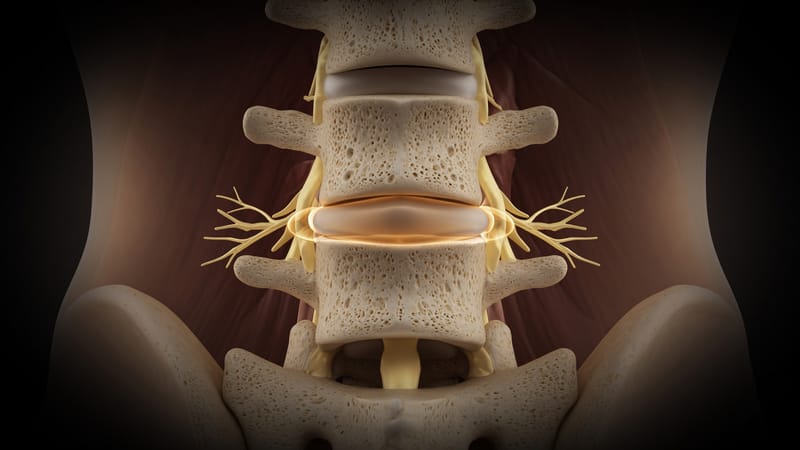
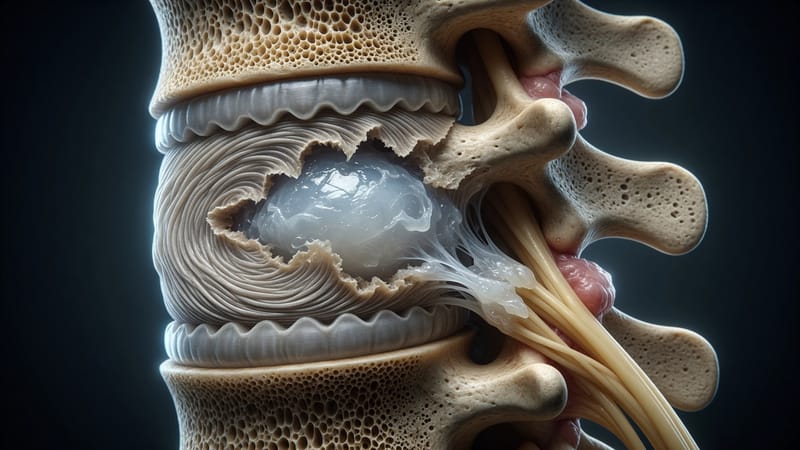
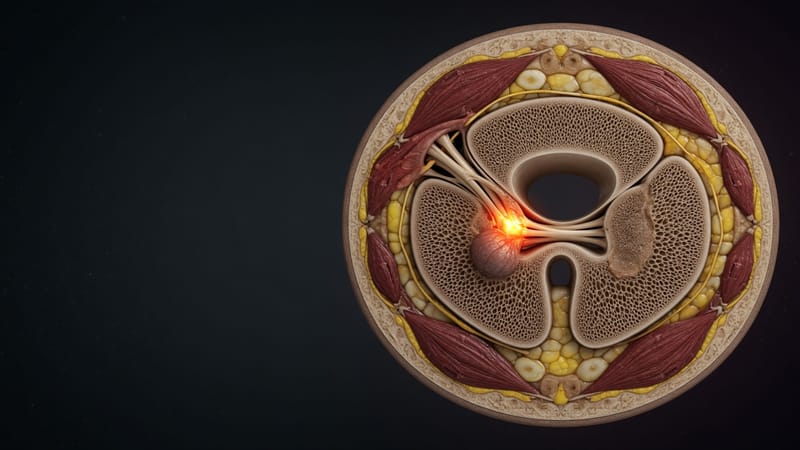
What the spine words look like
Radiology reports of the back lean on a small handful of disc words, and most people have never seen what they describe. Here is each one, drawn as a general anatomical illustration — an example of what the term means, not your scan, and not a diagnosis. Whether any of this is happening in your body is a question only your report and your care team can answer.


Once it makes sense
When the record is clear, you can act on it.
Understanding the record is the first step. If other paperwork is the problem, the plain-language decoder handles discharge summaries and letters. If a scan or lab was ordered but you don't have the images or report yet, the records requester writes the HIPAA request for you. And if insurance denied the scan or the care that follows it, decode the denial reason.
Questions
Common questions
Does anything I paste get sent anywhere?
No. Both the scan reader and the bloodwork reader run entirely in your browser on the text you paste. There is no account, no upload, and no server that receives your record — the only network activity on this page is loading its own static files. The one thing the page sends is a content-free view count that carries none of your text.
Is this a diagnosis, or telling me if my results are bad?
Neither. It explains what the terms and tests mean and shows each lab value beside a published typical range. It never calls a value good, bad, normal, or abnormal, never reads across your results for a pattern, and never diagnoses. A number outside a typical range is reported as a plain fact and handed to your doctor, who is the only one who interprets what it means for you.
Why does a value show as "above" or "below" the typical range?
Because that is a factual comparison of two numbers — your value and a published reference band — the same comparison your own lab report makes when it prints an H or L. It is not a judgment. Reference ranges vary by lab, method, age, and sex, so the range printed on your own result is the one that applies. When in doubt, your result and your clinician win over anything shown here.
Can it read my MRI or CT images?
No — and that is deliberate. There is no image upload anywhere on this page. Reading pixels to find disease is a regulated medical-device and diagnostic act; this page does the opposite job — it explains the report a radiologist already wrote, and it explains the lab values a lab already measured.
What if a term or test in my record isn't recognized?
It's left out rather than guessed at. The scan glossary and the lab table are fixed and human-reviewed; anything outside them is skipped so nothing invented ever appears. If something you need is missing, ask your care team, or suggest it and the tables grow.